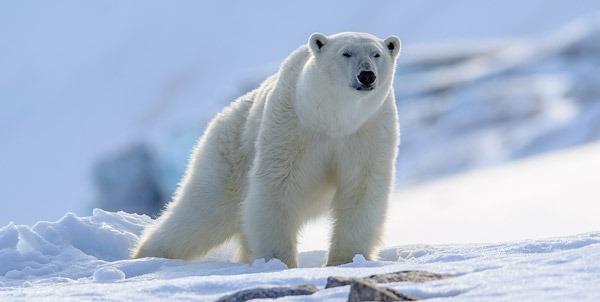
Polar bear: the largest terrestrial carnivore is a semi-aquatic mammal
The polar bear lives in the Arctic territories, the geographical region surrounding the North Pole, located north of the Arctic Circle.
It is the largest existing carnivore on our planet along with the Kodiak bear.
Adult males range in weight from 350 to 700 kg and in length from 2 to 3 meters.
Females, although smaller, can still weigh 150 to 300 kg.
Why polar bears are white
One of the best-known features of polar bears is their coat, which takes on the white coloring known to us.
However, the polar bear’s fur is not really white, but transparent and hollow; this allows light to be refracted thus giving the illusion of a white color.
This evolutionary adaptation helps camouflage the animal in its icy habitat and also contributes to body temperature regulation.
The skin underneath is a black color that acts as an insulator and absorbs the sun’s heat.
White bears also possess a layer of fat up to 10 cm thick, which is essential for their survival in the frigid Arctic temperatures.
This combination of fur and fat allows the bear to maintain body temperature even when outdoor conditions are extremely cold, as in its habitat.
How polar bears hunt and what they feed on
Food intake is crucial to its survival, especially during the summer months when sea ice recedes and access to prey becomes more difficult.
The polar bear is a highly specialized predator and feeds mainly on seals, particularly Weddell’s seal and ringed seal.
It uses a technique known as “ambush” to catch seals: it hides near openings in the ice where seals breathe, patiently waiting for the right moment to attack.
In addition to seals, polar bears may occasionally feed on the carcasses of whales and other marine animals but also on algae, fruits and roots, although these make up a small part of their overall diet.
How the polar bear moves through the water
Polar bears use their powerful front paws to swim, while their hind limbs act as rudders.
They are considered to be among the best swimmers in the animal kingdom, able to swim more than 90 km without stopping, which is essential for searching for food and moving between ice masses.
Its swimming abilities are particularly relevant in the context of climate change, where retreating sea ice is forcing them bears to swim longer and farther in search of food and territories where they can settle to mate and reproduce.
The survival of puppies
Reproduction typically occurs in late spring or early summer, with gestation lasting from 195 to 265 days.
Females build snow dens in which they usually give birth to one to three pups.
Their mother feeds them fat-rich breast milk, allowing them to grow rapidly and accumulate fat reserves.
Pups stay with their mother for about two years, during which time they learn vital skills for hunting and survival in the Arctic.
What’s happening to polar bears
During this period, mama bears face significant challenges as food availability can vary greatly and environmental change is threatening polar bear habitat.
The Arctic is undergoing dramatic changes due to global warming.
Temperatures are rising faster than in other regions of the world, causing sea ice to melt.
Declining sea ice has a direct impact on the hunting of seals, the main food source for polar bears, leading to increased competition for food and reduced population health.
Malnourished bears are less likely to reproduce and raise their cubs.
Polar bear populations are already shrinking and are expected to decline further, risking mass extinction by the end of the century.
Unfortunately, their disappearance is an indicator of something catastrophic that will soon overwhelm all living species, including our own.
And if we save polar bears, we save ourselves.
For your dog or cat, however, whether it is one for a checkup, vaccines and periodic check-ups, contact the veterinary doctors on our staff who are always available to you.
We would also like to remind you that Clinica La Veterinaria is always open h24 every day including holidays and with First Aid service from 8 pm to 8 am.
For the joy of seeing them HAPPY
©2025 -Text: Tiziana Genovese – Veterinary Technician