Saluki: the Persian greyhound is the dog sent by Allah
The Saluki, also known as the Persian Greyhound, holds a special place in dog history.
A symbol of Arab culture and a marvel of genetics, it passes on a thousand-year history of cooperation between man and animal.
It is a story that has spanned Mesopotamia, known as “the Fertile Crescent,” and has followed man’s evolution step, step to the present day.
The origins of the Saluki
The origins of the Saluki can be traced through a combination of genetic, archaeological and historical evidence.
Recent genetic studies suggest that the Saluki has existed for at least 6,000 to 8,000 years, but some experts speculate an even earlier origin, dating back about 9,000 years.
The Sumerians used it for hunting and left many engravings as evidence from the fact that these dogs were an integral part of their civilization.
Inanna, the Sumerian goddess of love, was always accompanied by 7 of these greyhounds she kept on a leash.
From the fertile “Crescent” of Mesopotamia, traders transported Salukis throughout the Middle East, where they became the valued allies of nomadic tribes.
This is evidenced by the remains of Saluki-like dogs found at archaeological sites in Arabia, Mesopotamia and Egypt where, moreover, frescoes and sculptures illustrate dogs with unmistakable graceful figures that strongly resemble him.
What Saluki means
For many centuries Bedouin nomads used them for hunting, and although dogs were declared unclean by the Islamic religion, a special exemption was made for the Saluki.
The term “Saluki” comes from Arabic and means“dog,” but not an ordinary dog, but rather the quintessential dog.
In fact, the Saluki was believed to be a gift from Allah to the tribes so much so that it was referred to as “El Hor” meaning the Noble One.
The recognition of race
In 1923, the breed was registered with the British Kennel Club, but its standard was not defined internationally until 1978.
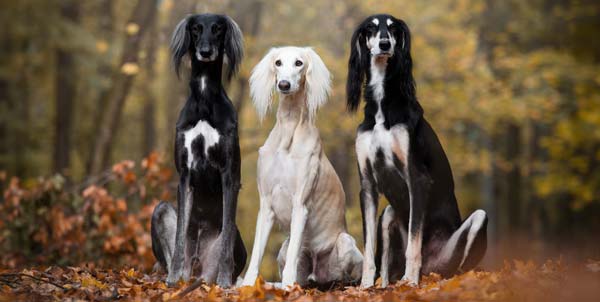
The Saluki ranges in height from 58 to 71 cm, weighing from 20 to 30 kg.
Its coat can be smooth or rough and can come in a variety of colors, including white, cream, gray and fawn.
The ears are long and pendulous, while the tail, is fringed and woolly.
With long, slender legs, sleek and streamlined, the Saluki seems to have been “designed” for speed: it runs in the wind.
The Saluki is among the fastest dogs in the world
Greyhounds such as the Whippet and Greyhound are known for their speed but the Saluki can reach as high as 70 km/h and can maintain this for long distances.
What makes the Saluki unique compared to other dog breeds and greyhounds in particular is precisely its incredible resilience, even in harsh environmental settings such as the desert.
That is why it has always been considered a formidable ally of man as well as an excellent hunter.
What is the character of the Saluki greyhound
Extremely gentle and sensitive, Saluki dogs tend to develop a strong emotional bond with their caregivers.
So, they tend to be very affectionate with their family, but can be aloof with strangers.
They love quiet and are not mall dogs or large crowds.
Salukis are very active dogs that need large spaces where they can run freely but safely.
A Saluki can live in an apartment
Salukis can also adapt to apartment living and appreciate couches and cushions on which to lie and rest, as long as their exercise needs are fully met.
This means long walks every day and frequent and regular exercise.
He is a dog that needs mental and physical stimulation: lack of exercise can cause boredom, malaise and frustration.
It is the ideal companion for young, active people who enjoy hiking in nature.
Always keep in mind that his innate hunter’s nature causes him to chase and grab what moves quickly and suddenly.
So, great care must be taken in the presence of other small animals, dogs, cats and children.
The recurrent pathologies of Saluki
Some of the common health problems include hip dysplasia, a genetic condition that affects the hip joint, causing pain and limitation of movement.
Some Saluki lines may be more vulnerable to congenital heart disease but also to eye diseases, such as cataracts.
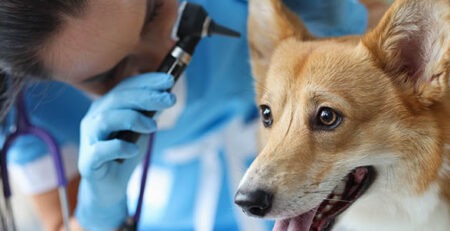
Ears require regular cleaning of the inside so as to prevent the development of mycosis and infection.
Prevention is key: regular vet checkups and a balanced diet can help maintain Saluki’s health and well-being.
To have your Saluki checked or for periodic check-ups, contact the veterinary doctors on our staff who are always available to you.
We would also like to remind you that Clinica La Veterinaria is always open h24 every day including holidays and with First Aid service from 8 pm to 8 am.