Basenji: The Villagers’ Little Dog
The name “Basenji” comes from the Bantu language, spoken in various regions of Central Africa, and can be translated as“little wild one”or“dog of the Basenji people.”
The term highlights this breed’s deep connection to the African land and culture from which it originates.
Its ancestors originated in Central Africa, where it was traditionally used by local tribes for hunting.
The earliest evidence of these dogs dates back more than 4,000 years, as shown by archaeological finds and some Egyptian cave paintings.
The Basenji was prized for its agility, stamina, and ability to hunt without barking—a trait essential for not scaring away game.
Recognition of the Basenji Breed
Over the years, the Basenji has retained many of its primitive traits, making it a true living link to the past of dog breeds.
In the 20th century, it was introduced to Europe and the United States, where it began to gain popularity as a companion and show dog.
It has been officially recognized by the major canine associations since the 1930s.
In the United States,the American Kennel Club (AKC) recognized the Basenji in 1943.
Physical Characteristics of the Basenji Dog
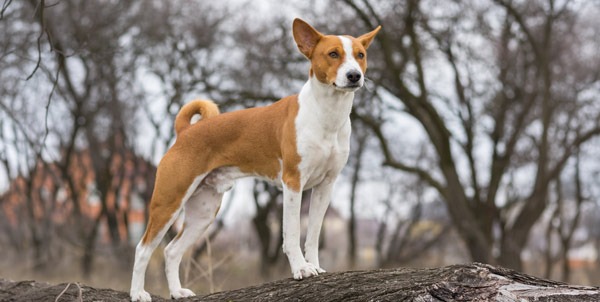
The Basenji has a slender, muscular, and athletic build.
This is a small-to-medium-sized dog, with a height at the withers that generally ranges from 40 to 43 cm and a weight of around 9–11 kg.
The coat is short, smooth, and soft to the touch, with colors ranging from red, black, and brindle to cream, with white markings on the feet, chest, tip of the tail, and sometimes on the muzzle.
A distinctive feature of this breed is its curled tail.
Basenji Temperament and Behavior
He is known for being extremely intelligent, curious, and independent, but also reserved and sometimes wary of strangers.
Another very interesting characteristic is that it almost never barks.
Basenji dogs actually make a series of melodious, short vocalizations similar to Tyrolean“yodels,” which are very different from the typical barking of all other dogs.
This characteristic is due to the unique structure of his larynx.
This is the perfect dog for anyone who loves the outdoors and is looking for a four-legged adventure companion.
Pathologies to pay attention to
Despite its primitive origins and historical selection in the wild, the Basenji is not immune to health problems.
Some of the most common health conditions that can affect this breed include:
– Fanconi syndrome: an inherited kidney disease caused by a recessive mutation in the FAN1 gene that results in the loss of important substances in the urine and can lead to kidney failure
– Progressive Retinal Atrophy (PRA) and cataracts
– Hip dysplasia: Although less common than in other breeds, it can occur and cause mobility issues
– Hypothyroidism
Regular veterinary checkups and targeted screenings are recommended for the prevention and early diagnosis of these conditions.
To have your Basenji’s urine tested on a regular basis, or for follow-up visits, vaccinations, and routine checkups, please contact the veterinarians on our staff, who are always available to assist you.
We would also like to remind you that Clinica La Veterinaria is always open h24 every day including holidays and with First Aid service from 8 pm to 8 am.