Chinese Crested Dogs—with or without hair: different looks, the same irresistible charm
The Chinese Crested is one of the most recognizable dog breeds in the world.
Although the name suggests a Chinese origin, the breed’s roots appear to trace back to ancient African hairless dogs.
During the Han Dynasty (206 B.C. – 220 A.D.), these dogs were taken aboard ships by Chinese sailors to hunt rodents, which helped spread them to Mexico and the Americas.
The Most Common Legends and Myths About the Chinese Crested
It is said that Chinese sailors brought these dogs aboard their ships to ensure a safe journey and protection from the spirits of the sea.
In fact, these dogs were considered such good-luck charms that they were present at ritual ceremonies as a sign of good fortune.
Their presence in Chinese noble households is documented: they were regarded as pets because of their beauty and affectionate nature.
The recognition of race
In China, the breed faced extinction due to the decline of the Chinese nobility following the rise of communism.
However, these dogs instead spread throughout the United States, and there, breeder Debora Wood (Crest Haven Kennels) made a crucial contribution; it is to her that the breed owes its survival.
In the 1960s, another breeder, Ruth Harris, imported the animals that form the foundation of the current breeding program to England.
Various breeds were included in the breeding programs for Chinese Crested Dogs, but the Xoloitzcuintle (the Mexican hairless dog) was periodically reintroduced to preserve the gene for hairlessness.
The Chinese Crested was officially recognized by the Fédération Cynologique Internationale (FCI) in 1987.
Physical Characteristics of the Chinese Crested Dog
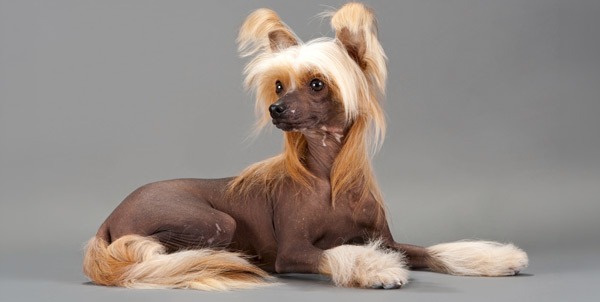
The Chinese Crested is a small dog, standing between 23 and 33 cm tall and weighing up to about 5.4 kg.
It comes in two varieties:
– Hairless: The body is hairless, except for the head (crest), the legs (socks), and the tail (plume); the skin is soft to the touch.
– Powderpuff : Entirely covered with a silky undercoat and a soft layer of long hair.
Character and Temperament of the Chinese Crested Dog
The Chinese Crested Dog is extremely affectionate and forms a deep bond with its owner, becoming distressed if left alone for too long.
He has a keen sensitivity and is attuned to people’s moods.
Generally friendly, it may show wariness or shyness toward strangers if not socialized early on.
Conditions to watch out for
Although it is a long-lived breed (13–15 years), it can be prone to certain genetic issues related to its anatomy:
– Eye problems: progressive retinal atrophy (PRA), glaucoma, and dry keratoconjunctivitis.
– Dental problems: common in the Hairless variety, which often has missing or malformed teeth due to a genetic link to hairlessness.
– Orthopedic problems: patellar dislocation and Legg-Calvé-Perthes disease (degeneration of the femoral head).
Hairless dogs require special care for their skin, while Powderpuff dogs need to be brushed regularly.
It is advisable to establish a grooming routine that includes baths, brushing, and skin checks to detect any irritation or signs of sunburn.
Feeding the Chinese Crested
Given their sensitive skin—especially in the Hairless variety—a high-quality diet is essential.
The Chinese Crested Dog’s diet should be high-quality, protein-rich, and balanced to support its fast metabolism and sensitive skin.
It is essential to feed your dog small, frequent meals to prevent digestive problems, opting for kibble specifically formulated for toy dogs or high-quality wet food.
Controlling calorie intake is essential, as this breed tends to gain weight.
To bring your Chinese Crested dog in for a checkup, periodic exams, personalized nutrition plans, and dermatological advice, contact the veterinarians on our staff, who are always available to assist you.
We would also like to remind you that Clinica La Veterinaria is always open h24 every day including holidays and with First Aid service from 8 pm to 8 am.