Table of Contents
Water turtles: do you really make them live well indoors?
Understanding the needs of water turtles in terms of species, temperature, feeding and behavior is essential to ensuring the long-term well-being of these magnificent creatures.
What breed are freshwater turtles
Freshwater turtles belong to several families and genera but Trachemys scripta is the most common in our homes.
Native to the United States, it is an alien species that is extremely invasive if released into the wild and that in the home, if placed in an environment that simulates its natural habitat, adapts well and lives long lives.
How to set up a suitable environment for aquatic turtles
The size of the aquarium is one of the most important factors to consider.
A freshwater turtle can reach considerable size and needs sufficient space to swim, explore and rest on an emerged area, so-called “basking.”
An aquarium of at least 200 liters is recommended for one or two adult turtles; for each additional turtle, an increase of at least 100 liters is recommended.
Height and length are equally crucial: turtles are skilled swimmers and need an area in which they can move freely.
Add objects such as rocks, aquatic plants and hiding places to stimulate their natural behavior.
What temperature should water turtles stay at.
The ideal temperature for a home aquarium is between 24°C and 28°C during the day.
In addition to water temperature, it is essential to provide a terrestrial heat source, such as a heated island or UVB lamp, where the turtle can come out of the water and warm up.
This also promotes the synthesis of vitamin D3, which is necessary for calcium absorption.
To keep the water clean and healthy for the turtles, a high-quality filtration system should be installed, and some of the water should be replaced regularly.
PH and water temperature should always be monitored, and uneaten food debris should be promptly removed to avoid harmful bacterial growth.
What water turtles eat
The diet of freshwater turtles is varied and should be based on a mix of plant, animal protein and commercial foods.
Here are some examples of appropriate foods:
– Animal protein: fish, shrimp, insects (such as crickets and worms) and crustaceans.
– Vegetables: lettuce, kale, spinach, zucchini and carrots. It is important to avoid oxalate-rich vegetables such as spinach unless balanced with other foods.
– Commercial food: granules or pellets specifically for freshwater turtles, providing balanced nutrition.
Small, young turtles tend to be more carnivorous, while adult specimens may adopt a more herbivorous diet.
Why aquatic turtles get on top of each other
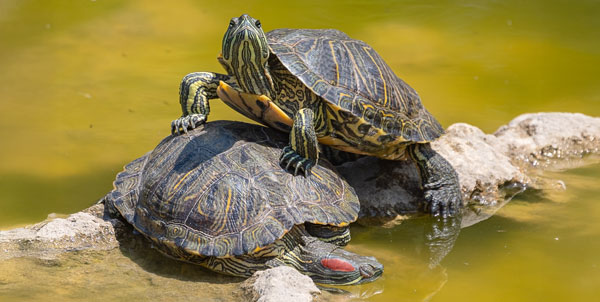
If your water turtles climb on top of each other, know that this behavior can have several explanations:
Turtles are social animals and may seek companionship or physical contact.
Or they huddle together to take advantage of heat from a source, such as a heat lamp or a basking area.
This behavior helps them maintain their body temperature during the day.
In an aquarium that lacks sufficient space or footholds, turtles may find it natural to stack up to occupy in a few available spaces.
Overcrowding causes stress and can trigger behavioral issues.
The health problems of water turtles.
Decreased appetite or complete lack of feeding are important symptoms as well as buoyancy tilted to one side that may indicate pneumonia, but also intestinal disorders.
Water turtles can exhibit symptoms of metabolic bone disease (MOM) (due to calcium, vitamin D and UV deficiency) and hypovitaminosis A (causing eye problems and abscesses).
Prevention ALWAYS comes from a proper environment with proper lighting, clean water, and a varied diet.
Observation of feces and urine can also be very helpful in detecting health problems.
By examining them closely, you may detect the presence of tiny parasitic worms, pinworms, which in large numbers can create health problems and require antiparasitic treatment.
Should you notice:
- Inappetence
- Lethargy
- Sneezing or nasal discharge
- Injury or swelling on the skin or carapace
See an experienced reptile veterinarian immediately for an accurate diagnosis and proper treatment.
What you should do if you find a water turtle
The keeping of both land and aquatic turtles in Italy is regulated by Law 150/1992, which implements CITES.
This law is essential to prevent illegal trade and ensure that turtles are treated with due respect.
The law states that every turtle belonging to protected species must be reported to the CITES Service, now run by the Carabinieri Forestali, within 90 days of acquiring the animal.
Captive births must also be reported within 10 days.
Another key requirement is microchipping .
Those who keep turtles without having reported them risk criminal penalties and seizure of the animal.
Before buying or taking in a tortoise, it is therefore essential to verify that the specimen is accompanied by a CITES certificate and microchip, and to make the mandatory reports.
Even in the case of a gift, the same rules apply: you cannot accept a turtle without the required documentation, because the animal would be illegal for all intents and purposes.
If you come across a water turtle, you must first identify whether it is a native species (Emys orbicularis) or an invasive species such as Trachemys scripta.
In the case of a native species and it is in its own environment, leave it quietly in place.
In case of an invasive species, contact the Carabinieri or the Forestry Department and ask for a recovery operation.
For consultations and checkups for your water turtle, contact us and we will refer you to a Veterinarian experienced in unconventional animals.
We would also like to remind you that Clinica La Veterinaria is always open h24 every day including holidays and with First Aid service from 8 pm to 8 am.