Dogue de Bordeaux: as majestic and imposing as it is gentle and peaceful
The Dogue de Bordeaux, also known as the French Hound, is a dog breed characterized by a muscular and robust appearance, powerful but agile.
Native to France, this dog has an ancient history dating back centuries when it was used for guarding and hunting.
History and origins of the Dogue de Bordeaux breed
The origins of the Dogue de Bordeaux are shrouded in mystery, but are believed to be closely related to the fighting dogs and working animals that populated the Gascony region of France.
It is speculated that the breed has descendants from the molossi of antiquity, used by the Romans for fighting and defense.
The earliest documented accounts of this dog date back to the 14th century, when it was described as a herding and defense dog.
During the 19th century, the Dogue de Bordeaux began to be officially recognized as a breed, with specific standards established by the allocation of dog clubs and associations.
However, World War I and World War II led to a sharp decline in the breed, reducing it almost to extinction.
It was not until the 1970s, thanks to the efforts of dedicated enthusiasts and breeders, that the Dogue de Bordeaux experienced a renaissance, becoming a popular dog outside France as well.
The physical characteristics of the Dogue de Bordeaux
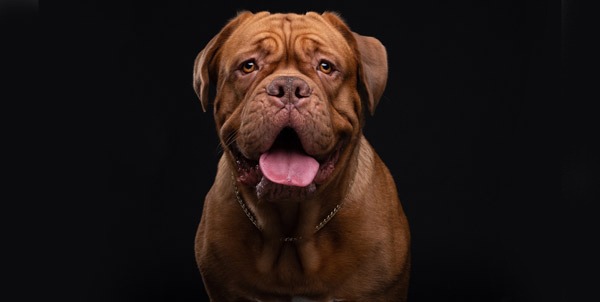
The Dogue de Bordeaux is immediately recognizable by its imposing and muscular physical structure, with a massive and well-proportioned body.
Large in size, the Dogue can weigh between 45 and 65 kg, with males reaching a height of 60-68 cm and females measuring between 58-66 cm at withers.
The really voluminous head is massive with a broad skull, while the muzzle is short, broad and has a slight crease on the forehead.
The coat is short, smooth and usually fawn in color, which can range from light to dark red, and may have shades of brindle (striped) or white spots on the chest and legs.
Temperament: what temperament the French Mastiff has.
Despite its physical impressiveness, the Dogue de Bordeaux is a gentle and peaceful dog.
Although he has a strong protective instinct, he is always very alert to warning signs but is not aggressive.
It is known to be an extremely affectionate dog toward its family, showing a particular inclination to protect children.
The principle always applies that teaching children how to interact respectfully with the dog will help create a safe and harmonious environment for all.
Proper socialization from a young age is necessary to enable the Dogue to develop a balanced character and so that it can always manifest its gentler side.
The Dogue de Bordeaux is famous for its strange “tail wagging”-when it is happy, its entire body seems to move along with its tail, creating a comical and affectionate image.
Living in an apartment with a Dogue de Bordeaux
Apartment living with a Dogue de Bordeaux is possible, but there are some considerations to keep in mind.
First of all, because he is a bit “bulky,” he needs fairly large spaces to move around just enough, because he is actually a fairly lazy and sleepy dog.
In any case, laziness aside, he needs long regular daily walks and playtime in open spaces.
The Dogue De Bordeaux is a dog that drools a lot, especially after eating or drinking so, it is not a dog for picky eaters and cleanliness freaks.
He tends to snore and make a lot of noise when he breathes because of the peculiar conformation of his snout, typical of Molossoids.
It suffers cold during the winter season but also heat during the summer.
Finally, he is a dog who loves physical contact: the closer he can be to his human, the happier he is.
Pathologies to pay attention to
Common health issues in the breed include hip dysplasia and elbow, hereditary conditions that can cause pain and motor difficulties.
Other health problems include heart disease, eye disease and gastric torsion, a serious condition that can occur in large dogs.
To prevent the onset of these diseases, it is essential to give your dog regular veterinary checkups, provide a balanced diet and maintain an adequate level of physical activity.
Weight management is essential, as theobesity can further aggravate joint problems and other health disorders.
To have your Dogue de Bordeaux checked, for periodic checkups and vaccines contact the veterinary doctors on our staff who are always available to you.
We would also like to remind you that Clinica La Veterinaria is always open h24 every day including holidays and with First Aid service from 8 pm to 8 am.