The Russian hamster: the rodent with adorable cheeks
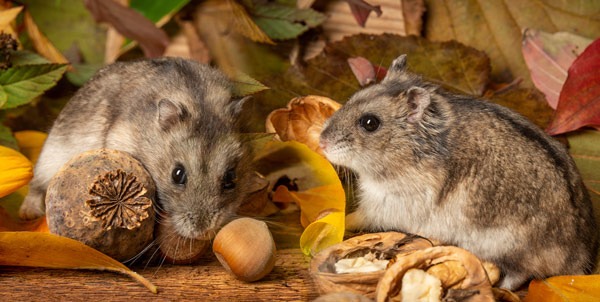
The Russian hamster, also known as Campbell’s hamster (Phodopus campbelli), is a tiny rodent native to the steppes Central Asia, Northern Russia and Northern China.
About 8-10 cm long, the Russian hamster weighs just 30-40 grams and is entirely covered with thick grayish-brown fur on its back while the lower half of its body is creamy-white.
Lively and curious, it has its own peculiar feature namely the cheeks that it fills with food and which give it a funny air.
Why hamsters keep food in their cheeks
Hamsters, including Russian hamsters, possess cheek pouches that they use to carry food.
This morphological feature is an evolutionary adaptation that allows them to gather food and take it to their nest, where they can safely consume it.
Such behavior is particularly advantageous in the wild, where food may not always be available.
What Russian hamsters eat
Their diet in the wild consists mainly of hay, seeds and grains.
They need a constant source of dry food, which can be mixtures formulated specifically for hamsters.
The Russian hamster’s teeth are continuously growing, so it is advisable to provide the animal with twigs to munch on in order to keep the incisors at a suitable length.
When kept in captivity, specific feed for this type of rodent can be used.
Fresh vegetables and fruits may be offered as long as they are in small quantities.
How to keep a Russian hamster at home
First, it is crucial not to underestimate the size of the cage; a cramped space can lead to stressful behavior and health problems
The cage, made of Plexiglas or plastic, should be provided with appropriate facilities such as running wheels, tunnels and shelters to ensure a stimulating and fun environment.
Gridded bottoms, which are uncomfortable and inappropriate for the small paws of these rodents, are strictly prohibited.
Rather, an absorbent, non-toxic material should be placed on the bottom of the cage.
Littering should be changed regularly to maintain a clean and healthy environment.
The ideal temperature for the Russian hamster is around 20-22 degrees, away from drafts and direct heat sources.
The coexistence of Russian hamsters
It is common to wonder whether Russian hamsters can live together.
In general, they are social animals and can often cohabit peacefully if introduced properly.
However, it is crucial to note that not all Russian hamsters are adapted to group life.
Placements should be between individuals of the same breed and age, and cages should be spacious enough to avoid territorial conflicts.
Mistakes to avoid when caring for a Russian hamster
When keeping a Russian hamster, there are some common mistakes to avoid.
A common mistake is the feeding of inappropriate food.
Avoiding toxic or inappropriate foods, such as chocolate or foods high in sugar, is essential for the animal’s health.
In captivity, a hamster may develop stress behaviors if it does not have enough space or stimulation.
In addition, it is crucial not to neglect regular veterinary visits.
Hamsters are not toys for children
Their small size and adorable appearance make them attractive as living “toys.”
However, it is crucial to understand that hamsters, while being pets, should not be treated as mere playthings.
Hamsters need daily attention-these responsibilities require a certain level of maturity that children are ready for.
Entrusting the care of a hamster to a child without proper guidance can lead to neglect, interactions that are stressful for the animal, or even mistreatment.
Common pathologies in Russian hamsters
Common illnesses include respiratory infections, which can result from an unhygienic environment or temperature changes.
Other conditions include tumors, dental diseases and skin problems.
It is important to carefully observe the hamster’s behavior and consult a veterinarian specializing in exotic animals if there are changes in behavior, diet or physical appearance.
To refer your Russian hamster for a checkup, advice on feeding or management, contact us to schedule an appointment with a veterinarian experienced in unconventional animals who works with our facility.
We would also like to remind you that Clinica La Veterinaria is always open h24 every day including holidays and with First Aid service from 8 pm to 8 am.