Table of Contents
Akita Inu, the reserved and silent Japanese dog
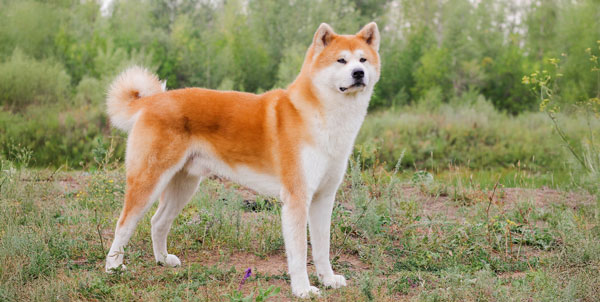
The Akita Inu is a dog breed from Japan, specifically the mountainous region of Honshu, and its origin dates back nearly 3,000 years.
The term “Akita” comes from the prefecture of origin while “Inu” in Japanese means “dog” therefore, “Akita Inu” literally translates to “Akita dog.”
Matagi Inu: the ancestor of the Hakita Inu
It is likely that its ancestor was the Matagi Inu (literally hunting dog), employed in hunting bears and wild boars.
The Matagi was later crossed later in the 1800s with the Tosa and Mastiff to obtain fighting dogs.
Fortunately, in 1908 dogfighting was banned and Akita were assigned to guarding.
The breed risked extinction during World War II, and it was only through the efforts of enthusiasts and breeders that the Akita Inu was preserved and saved.
Today, the Akita Inu is considered a national treasure in Japan and has received official breed standard recognition from the FCI (Fédération Cynologique Internationale).
World notoriety comes with Hachiko
But it was in the 20th century that the Akita Inu gained worldwide notoriety through the story of Hachiko, the dog who waited for years at Shibuya Station in Tokyo for the return of his human, who unfortunately passed away.
And on that very spot stands a statue in his honor.
The size of the Akita Inu
The Akita Inu breed is large in size and there is no “small” or dwarf version.
The mistake stems from Akita being confused with the small-sized Shiba Inu: both are Japanese dogs but they are different dog breeds.
A male Akita averages 67 cm in height and weighs between 30-45 kg, while the female reaches 61 cm in height for a maximum weight of 30 kg.
What is the character of the Akita Inu
However, the story of Hachikō demonstrates that, as much as Akita are notoriously reserved dogs who are cautious of strangers, they are capable of forming bonds of deep affection with their humans.
Another important aspect of the Akita’s character is its intelligence, sometimes accompanied by a certain stubbornness.
and again, the Akita Inu’s bark is deep and powerful but, as the reserved and quiet dog that he is, his vocalizations are limited to warning signals or to communicate the presence of strangers.
How to care for an Akita
Caring for an Akita Inu requires commitment and dedication.
It is essential to provide them with a stimulating environment both physically and mentally.
Akita need daily walks and recreational activities to maintain good health and prevent destructive behavior.
Most importantly, it is important to socialize the dog from puppyhood.
A coat suitable for harsh climates
Fur care requires attention, as the Akita has an extremely thick coat with a dense, thick undercoat.
Especially during molting periods, it is advisable to brush it regularly to remove dead hair.
The Akita Inu is a breed that is well adapted to cold climates, however, it is still important to provide shelter from low temperatures.
This is equivalent to saying that it should absolutely not be left outside and be left outside for long periods without adequate protection.
What can an Akita Inu dog eat
An Akita Inu’s diet should be balanced and nutritious, taking into account its age, weight and activity level.
Portions should be adequate and divided into two meals a day to avoid digestion problems.
To refer your Akita Inu for vaccines or check-ups and periodic check-ups, contact the veterinary doctors on our staff who are always available to you.
We would also like to remind you that Clinica La Veterinaria is always open h24 every day including holidays and with First Aid service from 8 pm to 8 am.