Table of Contents
Land tortoises: the allure of slowness
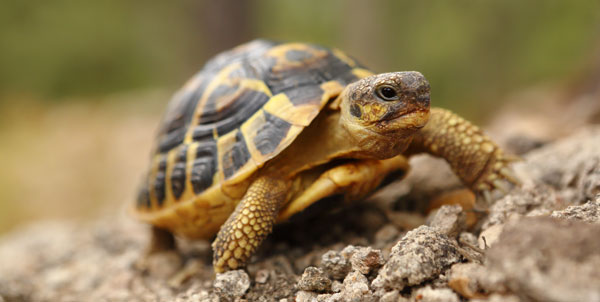
La Testudo hermanni (Hermann’s tortoise) is the main native species of land tortoise in Italy.
Other species introduced for ornamental purposes, such as Testudo graeca, Testudo marginata and Trachemys scripta, are widespread but of non-Italian origin.
It is a protected species, which mainly lives in habitats typical of Mediterranean areas and is widespread in our homes and gardens
However, most turtle diseases are related to mismanagement, especially in relation to hibernation, improper feeding, and poor information about species characteristics.
How to create a land tortoise habitat
To create a suitable environment for a land tortoise, it is essential to reproduce its natural habitat.
Land tortoises need space to move and dig, so a sufficiently large outdoor area or terrarium is essential.
In addition, it is important to provide enrichment elements such as rocks, logs and safe plants to ensure a stimulating environment.
How to set up a terrarium for terrestrial turtles
Setting up a terrarium for land tortoises requires attention to several factors.
First, the size of the terrarium should be proportionate to the size of the turtle.
An adult land tortoise needs a terrarium of at least 2 square meters; if there are more than one tortoise, the available space should be increased proportionately.
If the terrarium is located indoors, it is essential to place is a reptile-specific UVB lamp necessary for the synthesis of vitamin D needed to fix calcium.
The outdoor enclosure, on the other hand, should be set up by placing canopies that create shaded areas where the turtles can take refuge during rain or to fend off hot summer days.
The fencing material should be buried at least 40 cm underground: turtles are test-diggers and this expedient prevents them from escaping.
Turtles should always have a small 2/3 cm deep pool of water or a drinking bowl available.
What soil to use for turtles
The terrarium substrate, at least 25 cm deep, must ensure good drainage so it should consist of universal potting soil (40 percent), peat (40 percent) and sand (20 percent), obviously free of any kind of chemical contaminants.
This substrate should be kept moist but not wet, to simulate natural conditions.
Clay or compacted soils are absolutely to be avoided because they may hinder the turtles’ digging abilities and cause stress.
What the land tortoise eats
Land tortoises are primarily herbivores and require a diet rich in fiber.
A good diet includes green leaves, flowers, herbs and fresh vegetables.
Some of the favorite foods are chicory, dandelion, clover, and green leafy vegetables such as lettuce.
One must, however, avoid foods rich in oxalates, such as spinach, and fatty foods that can impair their digestion.
In addition, it is good to supplement the diet with calcium to promote bone and armor health.
Reproduction of land tortoises
Land tortoises reach sexual maturity around 5-7 years of age, depending on the species and environmental conditions.
During the mating season, which generally occurs in spring, males begin courting females.
After mating, females lay eggs in nests dug in the ground, usually between May and July.
The number of eggs can range from 2 to 15.
The eggs hatch after an incubation period that can last from 60 to 90 days, depending on the ambient temperature.
Once hatched, the baby turtles are independent and start foraging for food on their own.
When do land tortoises hibernate
Hibernation is an absolutely necessary metabolic phase and should be prevented only in exceptional cases, that is, if the turtle is sick or debilitated.
In the early fall days, turtles stop feeding to completely empty their intestines of food debris.
Around November, they begin to bury themselves (as much as 10 to 20 cm) or shelter under piles of dry leaves and shrubs, fall into hibernation, and then awaken between February and March.
The ideal hibernation temperature is 5 °C; temperatures below 2 °C cause brain damage or death; those above 10 °C induce them into a state of dormancy that is dangerous due to the depletion of fat stores needed to get through the winter.
Hibernating turtles are completely defenseless and must be protected from both rodents and cats.
Awakening from hibernation
Awakened from hibernation, it will take about a week for the tortoises to start eating regularly again.
On these days it is important to give them baths of about 10 mn. with lukewarm water to rehydrate, making sure the level is low to allow her to keep her head out of the water to breathe.
If the animal remains lethargic, with unopened eyes, and does not resume physiological functions within a few days of awakening, the Veterinarian should be contacted.
Carapace pyramidalization and other turtle diseases
Land tortoises can be prone to various diseases, many of which are related to diet and habitat.
The most common diseases include respiratory syndrome and mouth infections.
The pyramidation of the carapace, then, is a deformation of the shell scutes.
The scutes of the shell, the individual squares that form the carapace, rise and grow abnormally, taking on a pyramid shape.
This condition is caused by dietary imbalance (e.g., calcium deficiency, protein excess) and/or inadequate environmental conditions (insufficient humidity)
It is crucial to monitor the animal’s behavior and feeding and to consult a reptile veterinarian at the first sign of illness.
Who to call if you find a land tortoise
Since 1992, it has been mandatory to report possession of land tortoises to the Forest Service-CITES.
For turtles that are in possession before 1995, nothing needs to be done, while for those in possession after 1995, microchip inoculation is required.
In addition, the Convention on International Trade in Endangered Species in fact stipulates that you cannot have a land tortoise in your home that was born in the wild and found outdoors.
If you find a land tortoise in the garden, know that taking it to keep it with you is an illegal act.
Contact the Forest Service to report the find and ask for instructions, only if the turtle is in an urban or busy area and and may be in danger.
If not, leave it quietly in its habitat.
In the case of a sale by a retailer or breeder, each specimen must have a CITES certificate.
And should they lack them, DENUNCE them immediately because they are incurring the crime of exotic animal trafficking or poaching.
To have your land tortoise screened, for nutritional advice and advice on proper management, contact us and request an appointment with one of our Veterinarians experienced in unconventional animals.
We would also like to remind you that Clinica La Veterinaria is always open h24 every day including holidays and with First Aid service from 8 pm to 8 am.