Table of Contents
Green iguana: changes color according to its moods
The green iguana, a reptile of the Saurian order, often perceived as an enigmatic and ancient creature, has occupied a significant place in the collective imagination of many cultures, especially in the regions of Central and South America, where these reptiles are most common.
Pre-Columbian civilizations, such as the Maya and the Aztecs, attributed symbolic meanings related to nature, strength and regeneration to iguanas.
Their ability to change color, camouflage and regenerate part of the tail was interpreted as a sign of connection with the spiritual world and life cycles.
The natural habitat of the iguana
The natural habitat of iguanas includes different types of ecosystems, ranging from tropical forests to coastal areas and islands.
These reptiles prefer warm, moist environments, where they can find shelter in trees or rock crevices.
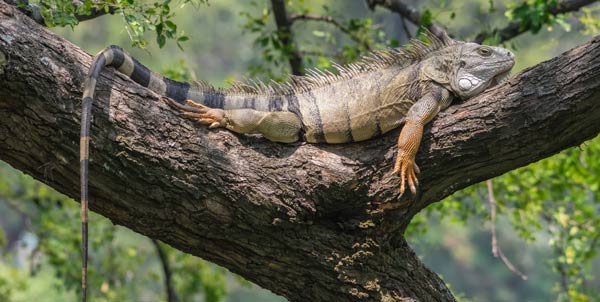
They are arboreal animals, so they often climb trees to escape predators and search for food.
When threatened, they may adopt a defensive posture, swelling their bodies and opening their mouths.
Morphology and growth of the iguana
Iguanas have an elongated and robust body, a long tail that they use to pounce on predators, a dorsal crest formed by spines, strong legs with sharp claws, and a gular pouch under the chin.
They are also equipped with a “third eye” or parietal eye on the head, which allows them to sense changes in light to detect predators.
Females are generally smaller than males, which have a more developed dewlap.
On average, common iguanas (Iguana iguana) can reach up to 2 meters in length, with a weight that can exceed 5 kilograms.
Other species, such as rock species (Ctenosaura), may be smaller, remaining under one meter in length.
The color changes of the iguana
The iguana changes color for reasons such as temperature, mood, courtship and maturity.
For example, it becomes darker to absorb heat from the sun and lighter to cool down, and it may take on brighter coloration during male-male encounters or courtship.
Age also influences, with the juveniles bright green and the older ones more grayish or bronze.
During skin shedding, which occurs several times during the year, the color change is most noticeable.
Many people wonder if iguanas are dangerous
Iguanas are generally not considered dangerous to humans.
Although they may bite if they feel threatened or are mishandled, their behavior is generally peaceful.
How to keep an iguana in the house
Iguanas can live up to 20 years in captivity, so you need to be prepared for a long-term commitment.
First of all, it is crucial to understand that these animals require large spaces and a stimulating environment.
A terrarium must be of adequate size to allow the iguana to move freely, ideally at least 2 meters in length.
It is also advisable to have natural elements such as branches and plants that provide shelter and opportunities for climbing.
The characteristics of the terrarium
The terrarium should be well ventilated and kept at optimal temperatures.
Iguanas need a thermal gradient, with a warm part where the temperature can reach 35-40°C and a cooler part around 25-28°C.
Humidity should be kept around 60-80%, and a misting system can be helpful to ensure optimal levels.
The availability of sunlight is critical for their development, as vitamin D3, synthesized through UV exposure, is essential for their bone health.
Reproduction and mating of the iguana
Iguanas reach sexual maturity around 2-3 years of age.
During mating season, males begin courting females through behaviors such as head lowering and swinging.
Breeding iguanas in captivity requires adherence to specific conditions of sexual maturity, environment (space, temperature, humidity, light) and diet.
Mating occurs in the dry months, with the male likely to show intense coloration.
The female lays a variable number of eggs (20 to 70 depending on the species), which must then be incubated under controlled conditions (28-36°C), with the incubation period lasting about 60-90 days.
The correct diet to keep an iguana healthy
To keep an iguana healthy, it is necessary to provide a balanced diet consisting mainly of fresh vegetables (about 90 percent) and fruits or flowers (about 10 percent).
It is essential to monitor the animal’s health, paying attention to signs of malaise such as weight loss, lethargy or changes in feeding behaviors.
Regular consultation with an experienced reptile veterinarian is recommended to prevent illness and treat any diseases.
Common pathologies
Iguanas can be prone to various diseases, including respiratory problems, metabolic bone diseases, bacterial infections, and intestinal parasites.
Metabolic bone disease is a common condition in captive iguanas, usually caused by calcium and vitamin D deficiency.
It is necessary to implement a proper diet and provide UVB light exposure to prevent this condition.
Other symptoms to watch out for include dull scales, loss of appetite and abnormal behavior.
Proper health management and a favorable environment are crucial to ensuring a long and healthy life for iguanas.
To have your iguana checked out for advice on its management and feeding, contact us to schedule an appointment with one of the veterinary doctors experienced in unconventional animals with whom we collaborate.
We would also like to remind you that Clinica La Veterinaria is always open h24 every day including holidays and with First Aid service from 8 pm to 8 am.