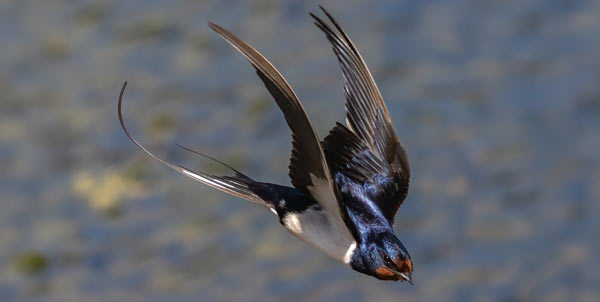
The swallow: magnetic fields show it the course
The swallow, a migratory bird belonging to the family Hirundinidae, is known for its skill in acrobatic flight but this is not its only talent.
Considered the migratory bird par excellence, it makes an extraordinary transflight each year that takes it from Europe to South Africa, thus flying more than 10,000 km.
One of the most remarkable characteristics of swallows is their incredible speed
The most common species are the common swallow (Hirundo rustica) and the collared swallow(Hirundo neoxena).
Their wings are long, pointed, the beak short, and the tail is forked, slightly longer in the male.
While weighing about 20 grams for an average length of 19 cm, swallows are able to reach flight speeds of more than 30 meters per second.
This quickness is accompanied by exceptional maneuverability, enabling them to perform rapid changes of direction and tight turns during their aerial evolutions.
Such skills are crucial, not only during flight, but also for catching insects, their main food.
Flight techniques of the swallow
Swallows use different flight techniques that amplify their effectiveness in searching for food.
Gliding flight, for example, allows them to conserve energy during long journeys, while beaten flight provides acceleration in situations where it is necessary to approach prey quickly.
Their strong and well-developed pectoral muscles provide the power needed to maintain active and prolonged flight, a key element in their survival.
Another fascinating aspect of swallows is their ability to orient themselves
During migration, swallows rely on a combination of factors, including the earth’s magnetic field, the position of the sun and stars, as well as visual cues provided by the geography of the location.
This sophisticated navigation is the result of millennia of evolution and adaptation.
Nest construction, also related to their flying skills, further highlights the exceptional nature of these creatures.
Where swallows nest
Swallows generally select strategic places to build their nests, especially in open environments such as fields, farms, and urban areas, where they can easily find the food on which they feed-that is, flying insects such as flies, mosquitoes, bees, and moths.
They build their nests near human settlements, taking advantage of structures such as stables, porches and house roofs-i.e., all those sheltered places to withstand the weather and protect their eggs and chicks from predators.
The ecological role of swallows
By catching and feeding on a wide range of flying insects that might otherwise become pests to agriculture, swallows help maintain the natural balance, promoting a healthy and sustainable ecosystem.
Suffice it to say that more than 120,000 insects are required to raise a brood.
However, in recent decades, the swallow population has undergone a marked decline.
Habitat loss due to urbanization and intensive agriculture has reduced nesting opportunities and access to food sources.
The use of agricultural pesticides has resulted in a significant culling of insect populations, depriving swallows of their main food source.
In addition, climate change affects weather conditions and the availability of suitable nesting and foraging environments.
Other threats come from the despicable practice of destroying their nests.
Destroying nests is a crime
Because swallows build their nests in close proximity to humans, they frequently experience direct interventions, such as removals and destruction of living structures.
This practice not only endangers the lives of adults and young people, but is also contrary to current legislation in many countries that protects wildlife.
In Italy, the law explicitly protects swallows and other wild birds by prohibiting their capture, killing, or damaging of nests, especially during the nesting period: such acts constitute a crime under Law No. 157/’92 andArticle 635 of the Penal Code.
The penalties are severe, but to address the swallow crisis, active conservation measures are essential.
How to help our swallow friends
First, information campaigns can help create awareness about the crucial role swallows play in the environment.
Another key action is the promotion of sustainable agricultural practices, reducing the use of chemical pesticides in favor of alternative methods of pest control.
In addition, installing swallow-specific nest boxes can facilitate nesting in urban and suburban settings.
These man-made structures can provide a safe and secure refuge, supporting the reproduction of the species.
What if you come across a young swallow that has fallen from the nest, contact the relevant local Wildlife Recovery Center(CRAS) and strictly adhere to the directions the experts will provide.
For your dog or cat, however, you can book an appointment with the veterinary doctors on our staff who are always available to you.
We would also like to remind you that Clinica La Veterinaria is always open h24 every day including holidays and with First Aid service from 8 pm to 8 am.