Table of Contents
Alaskan Malamute: The History of One of the Oldest Nordic Dog Breeds
The Alaskan Malamute is one of the best-known Nordic dog breeds, renowned for its extraordinary physical strength, resistance to cold temperatures, and independent nature.
It is often confused with the Siberian Husky, but in reality they are two distinct breeds with clear differences in physical build, temperament, and origins.
Unlike the Husky, the Malamute is larger and heavier; it is bred to pull heavy loads (not for speed) and always has brown eyes.
Origins and History of the Breed
The origins of the Alaskan Malamute can be traced back to the Inuit peoples of northwestern Alaska, specifically to the Mahlemut, from which the breed’s name is derived.
These dogs were bred to pull sleds loaded with supplies and food, traveling long distances in extreme weather conditions.
In addition to transportation, the Alaskan Malamute played a vital role in the survival of Arctic communities: it helped with hunting, protected camps, and provided support during journeys across the snow.
During the Klondike Gold Rush in the late 19th century, the demand for sled dogs increased significantly.
However, this period led to numerous uncontrolled crossbreeding, which jeopardized the purity of the breed.
It was not until the 20th century that a major breeding program began with the aim of preserving the Alaskan Malamute’s original characteristics.
The official recognition of the breed
TheAmerican Kennel Club officially recognized the Alaskan Malamute in 1935.
Subsequently, the Fédération Cynologique Internationale also classified the breed in Group 5, which is dedicated to primitive-type dogs.
Today, the Malamute is valued both as a companion dog and in dog sports related to sledding, hiking, and outdoor activities.
Physical Characteristics of the Alaskan Malamute
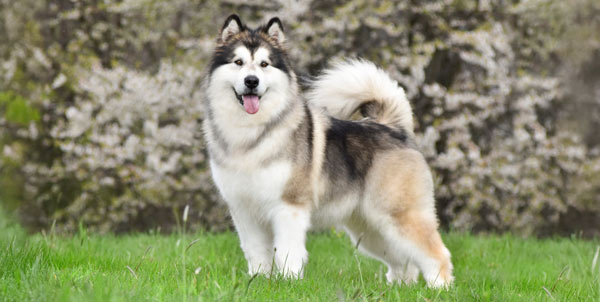
The Alaskan Malamute is a large-breed dog characterized by a powerful, muscular build.
Its sturdy construction perfectly reflects the purpose for which it was selected: towing heavy loads on snow-covered terrain.
Males ideally reach 63.5 cm at the withers and weigh about 38–40 kg; females are about 58.5 cm at the withers and weigh about 34 kg.
Its eyes are always brown (dark or amber), and it carries its tail curled over its back like a fluffy plume when it’s moving.
The Alaskan Malamute’s Temperament
In terms of temperament, the Alaskan Malamute is an affectionate dog.
Despite its imposing appearance, it tends to be friendly toward people and rarely shows aggression toward humans.
The Malamute needs plenty of space and daily exercise: a sedentary lifestyle and prolonged isolation can contribute to the onset of physical and psychological stress.
If properly socialized, it can live peacefully with children and other animals.
However, managing it requires time, skills, and a dynamic lifestyle.
Anyone who chooses this breed must be aware of its physical and behavioral needs and provide it with appropriate activities, stimulation, and attention.
The Alaskan Malamute doesn’t bark—it howls
The Alaskan Malamute’s howl is one of the most fascinating and primal forms of communication in the canine world, stemming directly from its nature as a primitive breed, which has preserved the ancestral behaviors of wild canids intact.
As a primitive breed, the Malamute much prefers to vary the pitch of its voice rather than let out short barks.
Through its howl, it calls to the members of its pack or signals its presence in the territory.
Furthermore, it howls to express excitement, intense joy, loneliness, or simply to “respond” to high-pitched noises.
When stimulated by a continuous sound, he tends to join in a full-fledged chorus—a sort of group song—along with other dogs.
Feeding and Caring for the Alaskan Malamute
Caring for an Alaskan Malamute requires special attention both in terms of nutrition and coat care.
The diet should be balanced and rich in high-quality protein, especially for highly active individuals.
It is essential to avoid being overweight and to spread out daily meals to reduce the risk of gastric torsion.
The coat is one of the Malamute’s most distinctive features: its double coat, consisting of a dense undercoat and a coarser, water-repellent outer layer, provides excellent protection against the cold.
It requires frequent brushing, especially during seasonal shedding periods, when hair loss increases significantly.
High temperatures can be a problem for this breed, which is naturally suited to cold climates.
Common Health Problems in This Breed
Like many large breeds, the Alaskan Malamute may also be prone to certain health conditions.
Among the most common are:
- hip dysplasia;
- elbow dysplasia;
- gastric torsion;
- cataracts and other hereditary eye conditions;
- hypothyroidism.
At Clinica La Veterinaria, you can schedule a preventive diagnostic checkup to assess your Malamute’s health and have the necessary specific tests performed on-site.
Contact us to schedule an appointment: our team of veterinarians is always here to help you.
We would also like to remind you that Clinica La Veterinaria is always open h24 every day including holidays and with First Aid service from 8 pm to 8 am.