Table of Contents
Vultures and the dirty work no one wants to do: yet they are among the most misunderstood birds on Earth
Despite widespread and unjustified mistrust, vultures represent a biological resource of inestimable value.
These extraordinary scavenging birds of prey carry out an invisible yet vital mission, cleaning up the environment like true scavengers—and at no cost.
The Ecological Role and Importance of Vultures
Imagine vultures as a 24/7 waste management system—completely free and with zero environmental impact.
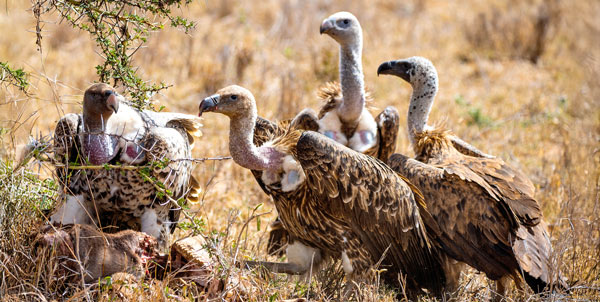
By feeding exclusively on dead animals, vultures clean up the environment before organic remains rot and become sources of infection.
Their digestive system is a true miracle of nature.
It has such high stomach acidity that it destroys spores and deadly bacteria such as anthrax, cholera, and botulism.
Without vultures, the carcasses would be eaten by rats, which act as vectors, spreading diseases to humans and livestock.
But not all vultures are the same.
Here’s how they differ and what incredible abilities they’ve developed to survive.
Species of Vultures and Their Characteristics
Scientists divide them into two major evolutionary groups that, although not closely related, have developed similar characteristics: Old World vultures (Africa, Europe, and Asia) and New World vultures (the Americas).
Here are the main species and their characteristics:
- The griffon vulture: native to Europe and the Mediterranean basin, it has a wingspan that can exceed two and a half meters. It lives in colonies and relies on its keen eyesight to locate carcasses.
- The Bearded Vulture: also known as the “lamb vulture,” it has a diet that is unique in the world, as it feeds almost exclusively on bones.
- The Egyptian Vulture: One of the smallest, it is the only migratory vulture in Europe.
- The Andean Condor: a member of the New World vultures, it is one of the largest flying birds on Earth and has a remarkable sense of smell.
Surprising Facts About Vultures
On the hottest days, New World vultures (such as condors and red-tailed vultures ) urinate on their own legs.
This behavior serves two purposes: the evaporating liquid cools the body (thermoregulation), and the extremely high acidityof the urine kills all the bacteria picked up while walking over decomposing carcasses.
The Egyptian vulture, on the other hand, is one of the very few birds in the world capable of using objects.
When it finds an ostrich egg (which is too hard for its beak), it looks for an oblong stone, grabs it with its beak, and repeatedly hurls it against the shell until it breaks.
Furthermore, the bearded vulture is famous for its orange-tinged plumage on its chest.
In fact, the natural color of its feathers is white, but it intentionally seeks out mud rich in iron oxide to take what are essentially “color baths.”
This behavior is related to dominance and social status within the species.
The Vulture’s Vomit
If a vulture feels threatened or is approached by a predator while feeding, it immediately regurgitates its digested food.
This serves two purposes: to immediately lighten its own weight so it can take flight more quickly, and to repel or blind the attacker with a highly acidic, foul-smelling liquid.
A bald head is a masterpiece of evolution
Since they feed by sticking their heads directly into the carcasses, their feathers would become saturated with blood and organic matter that is difficult to clean off, turning them into a breeding ground for bacteria.
Bare skin, on the other hand, is easy to clean and is constantly sterilized by the sun’s rays (UV rays) during the flight.
In short, the adaptability of these species is also reflected in their remarkable ability to colonize hostile, diverse, and geographically distant areas.
Habitat and Geographic Distribution of Vultures
Vultures are found on nearly every continent except Antarctica and Oceania.
Their distribution depends heavily on the presence of large open spaces and the availability of food.
They prefer African savannas, grasslands, semidesert areas, and major mountain ranges such as the Himalayas, the Andes, and the Alps.
To move around, they regulate their flight by taking advantage of rising warm air currents.
This allows them to plan their routes for hours and cover hundreds of kilometers a day with minimal energy expenditure.
In our country, thanks to significant reintroduction efforts, griffon vultures can be spotted in Sardinia, the Alps, and along the central Apennines, while the bearded vulture has returned to fly regularly in the Alpine skies.
Vulture Recovery and Conservation
Unfortunately, vultures are now among the most endangered groups of birds on the planet.
Their populations have suffered dramatic declines due to human activity and invisible threats:
Poisoning: They often ingest poisoned bait intended for large predators, or die from diclofenac, a veterinary drug that is highly toxic to them when present in cattle carcasses.
Infrastructure: Collisions with high-voltage power lines and wind turbine blades are a common cause of death.
Vulture Conservation Projects
Fortunately, awareness is growing. Extraordinary restocking and conservation programs are underway throughout Europe and in Italy.
Projects funded by the European Union operate controlled feeding stations (so-called “artificial feeding stations”) to ensure a safe food supply for birds of prey.
At the same time, wildlife rehabilitation centers care for injured animals and carry out captive breeding programs to release young animals born in the wild, ensuring constant monitoring through GPS trackers.
On the first weekend of September, in celebration of International Vulture Day, many parks, nature reserves, and wildlife rehabilitation centers in Italy organize birdwatching events and the release of birds that have been treated by veterinarians specializing in exotic animals.
The veterinarians on our staff, on the other hand, dedicate themselves every day to the health and well-being of dogs and cats, offering checkups and specialized diagnostic services.
For follow-up visits, routine checkups, and specialist appointments, please contact us to schedule an appointment.
We would also like to remind you that Clinica La Veterinaria is always open h24 every day including holidays and with First Aid service from 8 pm to 8 am.