Table of Contents
Stomatitis in Dogs and Cats: Symptoms, Causes, and Treatments
Stomatitis in dogs and cats is one of the most painful and debilitating oral conditions that can affect our four-legged friends.
This condition is not just a temporary case of gingivitis, but a serious chronic inflammation that turns everyday, essential activities—such as eating or cleaning oneself—into a real ordeal.
Understanding how to recognize the early signs of stomatitis in dogs and cats is essential to prevent unnecessary suffering and take action before the situation becomes irreversible.
What Is Stomatitis and Why Is It So Painful?
The term “stomatitis” refers to widespread inflammation of the mucous membrane lining the entire oral cavity.
Unlike gingivitis, which is limited to the tissue surrounding the tooth, stomatitis can spread to the tongue (glossitis), the lips, the palate, and even the back of the throat, an area known as the fauces (pharyngitis).
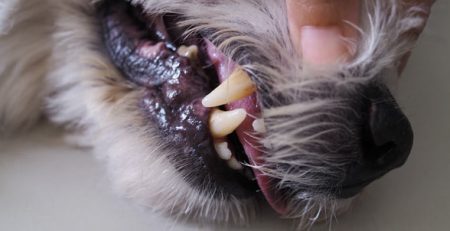
When this condition develops, the tissues in a dog’s or cat’s mouth appear extremely red, swollen, ulcerated, and prone to spontaneous bleeding.
For dogs and cats, just as for humans, having their mouths constantly covered with canker sores is extremely painful.
How to Recognize the Symptoms: Signs You Shouldn’t Ignore
Dogs and cats have a very high pain threshold and tend to hide their discomfort.
However, stomatitis causes such severe pain that it is impossible to hide it, and this discomfort is communicated through changes in their behavior:
-
- Loss of appetite and a fearful attitude toward food: The animal is hungry and approaches the bowl eagerly, but after the first bite, it recoils in fear, whimpers, or runs away.
- Difficulty chewing (dysphagia): Food keeps falling out of the mouth, or the animal tries to swallow it whole without chewing.
- Hypersalivation: Thick, stringy, and continuous saliva drips from the sides of the mouth. In severe cases, this saliva may be streaked with blood.
- Severe halitosis: The odor coming from the mouth becomes pungent and putrid due to tissue necrosis and bacterial proliferation.
- Lack of grooming (especially in cats): Cats with stomatitis stop licking themselves because the contact between their rough tongues and their inflamed mucous membranes is unbearable. The result is a dull, matted, and dirty coat.
- Weight Loss and Dehydration: Prolonged refusal to eat or drink leads to rapid weight loss and a state of general exhaustion.
- Behavioral changes: The animal becomes irritable, isolates itself, refuses to be petted on the snout, and may show aggression if someone tries to examine its mouth.
Causes of Stomatitis in Dogs and Cats
Stomatitis almost never has a single cause; it is considered a multifactorial, immune-mediated condition.
This means that the animal’s immune system reacts in a completely abnormal and disproportionate way to the bacterial plaque on its teeth, destroying its own tissues in an attempt to fight it.
However, there are substantial differences between the two species.
Chronic Feline Stomatitis: FCGS
In cats, this condition is called Chronic Feline Gingivostomatitis and is particularly aggressive.
In addition to genetic predisposition, the onset of the disease is strongly linked to the presence of latent viruses that weaken or alter the immune system:
-
-
- Feline calicivirus (FCV): isolated in the vast majority of cats with stomatitis
- FIV (Feline Immunodeficiency Virus) and FeLV (Feline Leukemia Virus): These retroviruses compromise the body’s defenses, causing chronic oral infections that are difficult to eradicate
- Breed predisposition: Breeds such as the Siamese, Persian, Maine Coon, and Sphynx have a higher incidence
-
Chronic Canine Ulcerative Stomatitis: CUPS
In dogs, this condition is often referred to as CUPS (Chronic Ulcerative Periodontal Stomatitis).
It primarily develops as a hypersensitivity reaction to tartar and dental plaque.
Ulcerative lesions typically form in areas of the mucosa that are in direct contact with teeth affected by tartar.
Small breeds such as the Maltese, the Cavalier King Charles Spaniel, the Cocker Spaniel, and the Greyhound are the most commonly affected.
Diagnosis of Stomatitis in Dogs and Cats
The veterinarian will first perform a visual examination of the mouth.
The proper diagnostic process involves:
-
-
- Complete blood work: to assess the function of internal organs and test the cat for FIV/FeLV.
- X-rays: to assess the condition of the tooth roots and the surrounding alveolar bone, which are often already compromised and resorbed.
-
Treatment: From Medical Therapy to Surgical Removal
The treatment of stomatitis has two goals: to relieve pain and to reduce the bacterial/antigenic load inside the mouth.
Strategies vary depending on the severity of the situation.
In the early stages or as a temporary measure, the veterinarian will prescribe:
-
-
- Anti-inflammatory and pain-relieving medications: to provide immediate relief and allow the animal to resume eating.
- Specific antibiotics: to control secondary bacterial infections.
- Local oral hygiene: application of gel or spray to reduce tissue inflammation.
-
When medical treatment is no longer sufficient and stomatitis (especially in cats) becomes chronic, the only real long-term solution is partial or total tooth extraction.
Although this option may be deeply frightening, extractive surgery represents a radical breakthrough.
By removing the teeth, you eliminate the physical surface on which bacterial plaque accumulates.
Without the irritation caused by tartar, the inflammation subsides.
Both dogs and cats without teeth can eat wet food and even small kibble without any difficulty once their gums have fully healed and the pain has subsided.
Prevention
It is not always possible to prevent pure immune-mediated stomatitis, but it is possible to drastically reduce the risk factors.
-
-
-
- Oral hygiene: Get your dog and cat used to using a toothbrush and pet-specific toothpaste from when they’re puppies and kittens (never use human toothpaste, as it is toxic).
- Regular checkups and tartar removal: Schedule regular checkups and have your pet’s teeth professionally cleaned with an ultrasonic scaler by your veterinarian as soon as tartar appears.
- Proper nutrition: Provide foods formulated for dental health or safe chew toys that help mechanically remove plaque.
- Vaccination prophylaxis: Keep vaccinations up to date, particularly the vaccine against feline calicivirus, to reduce the impact of viral triggers.
-
-
Don’t wait until your dog or cat stops eating altogether: take action right away to give them back the chance to live pain-free.
If you suspect your pet may have oral health problems, talk to your veterinarian right away.
To refer your dog or cat for a checkup, contact the veterinary doctors on our staff who are always available to you.
We would also like to remind you that Clinica La Veterinaria is always open h24 every day including holidays and with First Aid service from 8 pm to 8 am.