The gecko: a discreet roommate that keeps flies and mosquitoes away
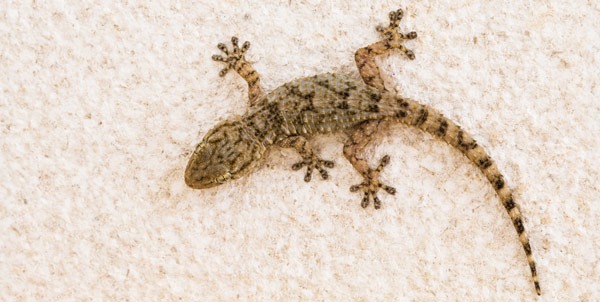
The common gecko most frequently found in Italian homes belongs to the species Tarentola mauritanica.
This small reptile is common in temperate and Mediterranean regions. It has a sturdy body, slightly grainy skin, and a coloration that ranges from gray to beige, often with spots that make it difficult to spot on surfaces.
It is a predominantly nocturnal animal: during the day, it tends to remain hidden in crevices, cavities, or sheltered corners, while at night it becomes active, especially in well-lit areas where insects congregate.
One of its best-known features is its ability to adhere to vertical surfaces and even to the ceiling.
How does the gecko hold on?
The surface of a gecko’s feet is covered with millions of extremely thin, thread-like structures called setae.
These bristles branch into even smaller structures called spatulas, which are nanometer-sized.
Each individual leg can have more than 500,000 setae, and each setula is divided into hundreds of spatules.
The hierarchical arrangement of the setae and spatulae allows geckos to take advantage of forces known as Van der Waals forces.
What Are Van der Waals Forces?
Van der Waals forces are invisible “electrical” attractions that occur at the atomic level.
A single Van der Waals force is insignificant, but the gecko has evolved a system to multiply its effect exponentially.
The moment the gecko places its foot and presses it downward, the adhesive pads stretch out and the adhesive force is maximized.
The enormous number of spatulas that come into contact with the surface generates a significant overall adhesive force capable of supporting the weight of the entire animal.
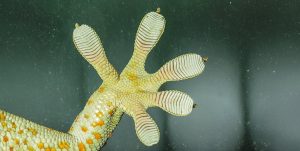
In practice, the contact area of the gecko’s feet produces a total adhesion that far exceeds the animal’s body weight, overcoming gravity and allowing these reptiles to walk on vertical surfaces or upside down.
When it needs to take a step, it changes the angle of its claws; the van der Waals force is instantly broken, and the leg detaches effortlessly.
Why Do Geckos Come Into the House?
The presence of a gecko is primarily linked to environmental factors.
The main reason is the availability of food: geckos are insect predators and are attracted to environments where prey such as mosquitoes, flies, moths, and spiders are abundant.
Artificial lights from homes attract insects, and consequently also the geckos that hunt them.
Its hunting strategy is based on waiting: it remains motionless until prey approaches, then pounces quickly.
In practice, its presence can be considered a form of natural “biological control” and plays a crucial role in the food chain.
By preying on insects considered pests, it helps maintain the balance of the ecosystems in which it lives.
It is important to remember that this is a wild animal: it should not be captured, kept as a makeshift pet, or even handled—especially because geckos lose their tails when faced with predators or other threats.
Tail Regeneration in Geckos
The loss of a gecko’s tail, known as autotomy, is a natural defense mechanism.
This is not simply a mechanical failure, but a reflex response controlled by the nervous system in situations of extreme danger or stress.
The gecko’s tail has predefined weak points, called “fracture planes,” located between the vertebrae.
These points are areas of cartilage or connective tissue that break easily.
When a gecko decides to shed its tail, it violently contracts the muscles around one of these fracture planes: this tension breaks the vertebra and cleanly separates the skin and tissues.
The tail continues to move and wriggle frantically for several minutes (up to 30 in some species) due to local nerve reflexes. This serves to distract the predator while the gecko escapes.
The tail regrows within a few weeks thanks to specialized cells that activate to form new tissue.
While the extraordinary biology of reptiles fascinates us, the health of our dogs and cats remains our day-to-day priority.
In this regard, the veterinary doctors on our staff are always at your disposal: contact them for any needs or information that may be useful for the well-being of your beloved dog or cat.
We would also like to remind you that Clinica La Veterinaria is always open h24 every day including holidays and with First Aid service from 8 pm to 8 am.
For the joy of seeing them HAPPY
©2026 -Text and image: Tiziana Genovese – Veterinary Technician
All rights reserved.